How Virtual Testing Simulations Predict Wear Patterns in Multi-Sport Footwear and Accessories Before Real-World Use Begins
Written by Parker Becker · Aug 4, 2026
How Virtual Testing Simulations Predict Wear Patterns in Multi-Sport Footwear and Accessories Before Real-World Use Begins
Virtual testing simulations have become central to footwear development, allowing manufacturers to forecast abrasion, material fatigue, and structural degradation across running shoes, soccer cleats, basketball sneakers, and related accessories long before any prototype reaches an athlete's feet. These digital environments replicate repeated loading cycles, surface interactions, and environmental variables through finite element analysis combined with computational fluid dynamics, generating data that correlates closely with laboratory wear measurements.
Core Simulation Technologies Driving Predictions
Engineers input material properties such as rubber hardness, foam density, and textile tensile strength into software platforms that divide each component into thousands of mesh elements. Each element responds independently to applied forces, revealing localized stress concentrations that indicate where tread lugs will erode first or where midsole cushioning will compress permanently. As of August 2026, several major brands integrate machine-learning layers that refine these models using anonymized data from previous product iterations, shortening the time from concept to validated design.
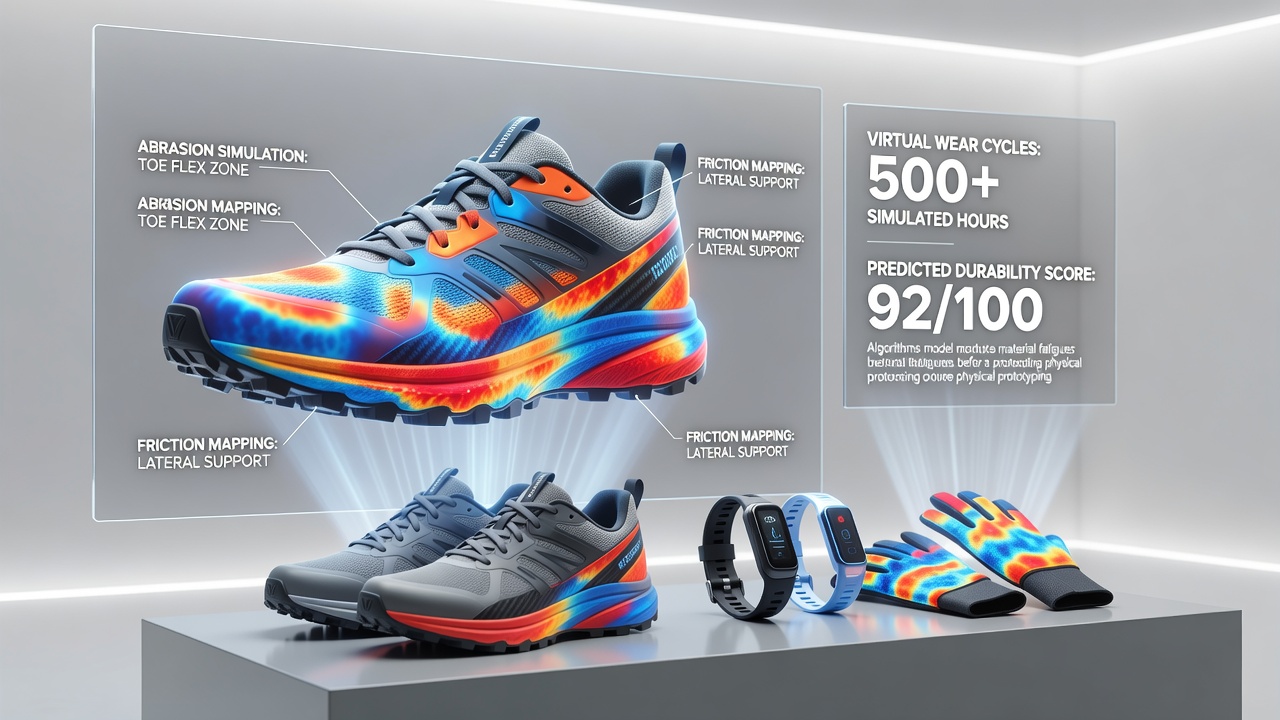
Simulations account for sport-specific kinematics by importing motion-capture data that defines how a soccer player plants a cleat during a cut versus how a runner strikes the ground at heel-off. The resulting contact pressures, shear forces, and sliding distances accumulate over millions of virtual steps, producing heat maps that highlight accelerated wear zones on outsoles and upper reinforcements. Accessories like ankle braces or insoles receive the same treatment, with their attachment points modeled for micro-movement that leads to stitching or hook-and-loop fastener breakdown.
Multi-Sport Applications and Pattern Forecasting
Running footwear experiences high-frequency, low-amplitude impacts on varied surfaces, while basketball shoes encounter torsional stresses from lateral cuts and vertical landings. Virtual models differentiate these profiles by adjusting friction coefficients and impact angles, predicting that a given rubber compound will lose 0.8 millimeters of tread depth after 800 kilometers on asphalt yet only 0.4 millimeters after equivalent court time. Soccer cleats add the variable of stud penetration into turf, where rotational torque at the stud-plate interface can initiate cracking that propagates through the midsole.
Researchers at institutions such as the Commonwealth Scientific and Industrial Research Organisation have published validation studies showing that simulation-predicted wear volumes fall within 12 percent of physical drum abrasion test results across multiple polymer blends. This correlation enables teams to iterate compounds or geometries dozens of times digitally before committing to tooling.
Integration with Digital Twin and Real-Time Calibration
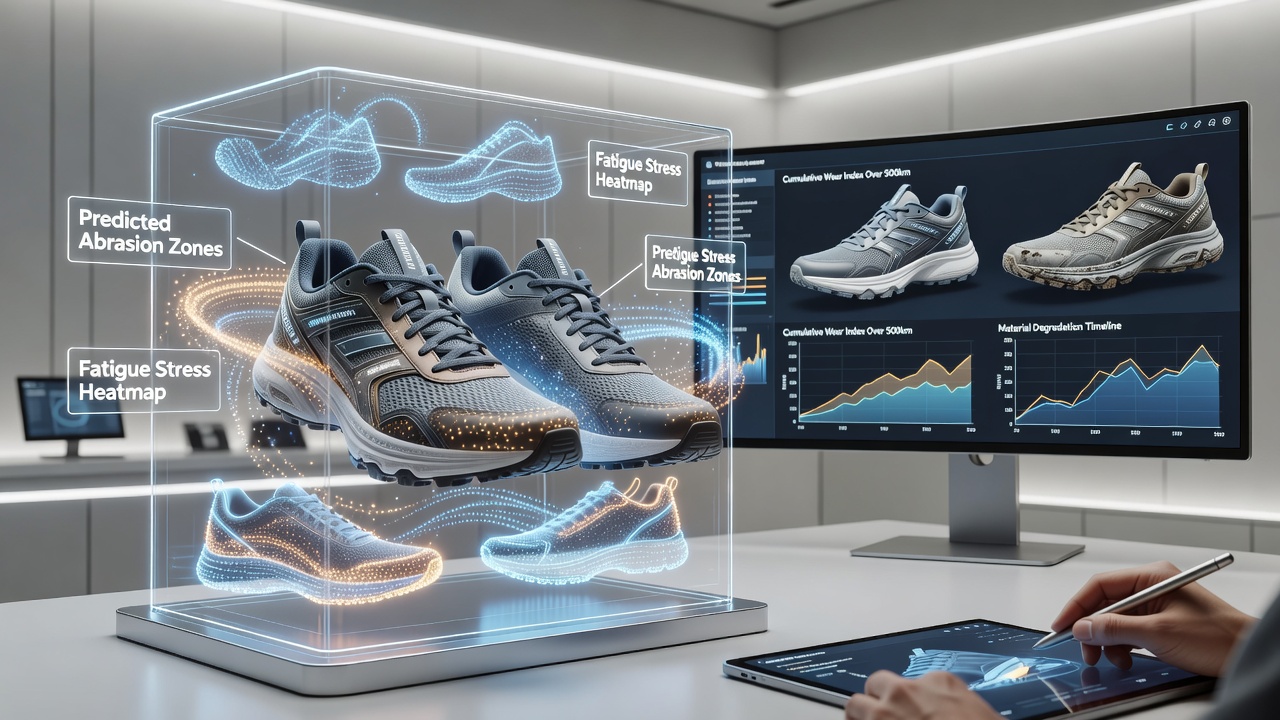
Digital twins extend the approach by maintaining a living model of each production batch, updated with sensor data once limited field trials begin. Discrepancies between predicted and measured wear trigger recalibration of input parameters such as viscoelastic response under elevated temperatures. One European consortium recently demonstrated that incorporating humidity cycling into the simulation reduced forecast error for swim-to-run transition shoes by 19 percent, because moisture absorption alters foam stiffness and therefore load distribution.
Accessory manufacturers apply the same framework to items like hydration belts and reflective straps, modeling how repeated flexing at buckle points creates fatigue cracks. The simulations also forecast color fading from ultraviolet exposure by coupling mechanical wear models with photochemical degradation equations, helping designers select pigments that maintain visibility ratings through an entire season.
Limitations and Validation Requirements
While computational speed has improved dramatically, simulations still require empirical calibration for novel material combinations or extreme environmental conditions such as prolonged exposure to de-icing salts on winter running routes. Industry reports from the National Research Council Canada emphasize that hybrid workflows, alternating between virtual runs and targeted physical verification, remain essential to maintain accuracy above 85 percent. Edge cases such as unexpected user behaviors, including dragging toes during serves in tennis, continue to challenge purely digital predictions.
Conclusion
Virtual testing simulations now supply footwear and accessory developers with quantitative wear forecasts that span multiple sports and usage environments. By combining advanced numerical methods with accumulating validation datasets, these tools reduce the number of physical prototypes required and accelerate the introduction of products whose durability profiles have already been mapped against real-world demands. Continued refinement of material models and integration with field telemetry promise further convergence between simulated outcomes and actual service life.